laptop with hand

A tepid economy: can AI warm it up?

The economist's corner

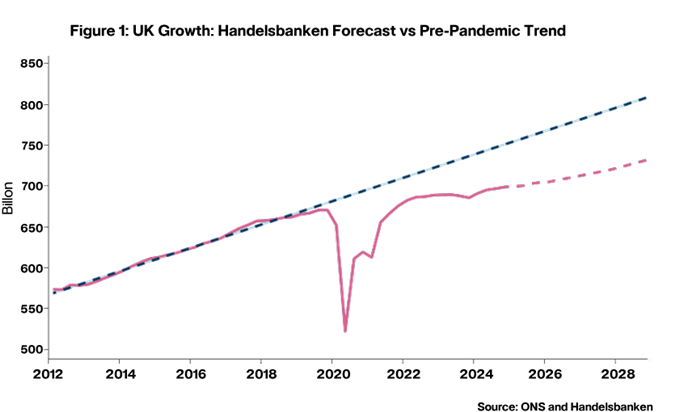
We kicked off the year at Handelsbanken with the publication of our latest Global Macro Forecast Opens in a new window. From a global perspective, there are some cautious signs of optimism that there could be steadier growth in 2026, although the UK macro outlook is one of fairly subdued growth over the next three years. There are some potential tailwinds to UK growth, including a possible fall in the household savings rate, improved relations with the European Union, and planning reforms. However, various structural problems such as high industrial electricity prices and issues with the UK labour market are likely to stymie growth. It is also notable that UK political risk is rising up the agenda with the governing Labour Party facing a tough by election later this month and a challenging set of local elections in May. 
-

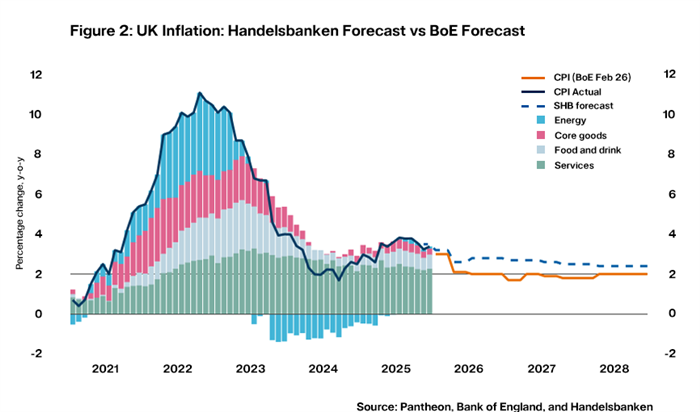
Our forecast is for inflation to be more stubborn than the Bank of England’s latest forecast currently predicts. We will see inflation drop dramatically from its current level of 3.4% down to near the Bank of England’s target in April, in large part due to the government moving levies on energy bills onto taxpayers. Yet services inflation and wage growth remain above levels compatible with the Bank of England’s target and headline inflation is likely to rise again by year end. We have talked in previous Rate Wraps about the risks around high consumer inflation expectations in the UK, but it is also worth bearing in mind that the UK’s inflation rate has historically been notably higher than the Eurozone’s by around 0.75pp since 2005. This trend could be due to the fact that the UK economy is more services-orientated than the Eurozone’s, which in turn means that it can take longer for headline rates of inflation to fall. Taking all of this into consideration, we have pencilled in two further rate cuts this year – which is broadly aligned with market expectations, but the inflation persistence concern means we currently do not envisage any further interest rate cuts in the forecast period to 2028. 
-

Pivoting onto a global macro issue, we have a theme article in the Global Macro Forecast which looks at the potential longer-term economic impact arising from trends in artificial intelligence (AI). So let’s briefly reflect on our thinking about how AI affects the longer-term macro outlook. 

We start by examining the adoption of AI by commerce. Adoption seems to be happening at a faster pace in the United States compared to Europe, but it still remains in its infancy across the western world. For example, just 7% of businesses using AI in the US have fully deployed it across their organisations, and it is notable that there are multiple barriers to adoption that continue to slow the rate of growth in AI use by commerce. Data centres are enormously energy-intensive — which of course puts Europe and the UK at a particular disadvantage given their industrial electricity costs are 2–4x those of the United States, and there are numerous barriers within firms that slow down adoption of AI, not least the issue of fragmented databases across organisations. 

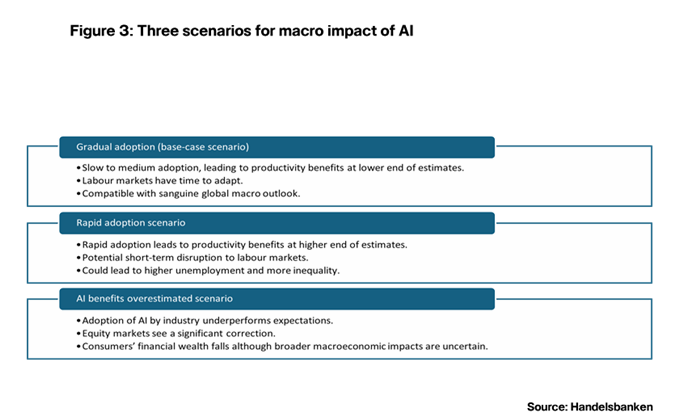
This leads us to a base case view of “gradual adoption” of AI. Our colleagues in Stockholm estimate that this could still increase productivity growth by 0.7pp per year on an annual basis over a ten-year period in Sweden. The benefits could even be slightly higher in the UK given the economy is especially strong in sectors that are AI-exposed.  This is not quite the sort of productivity gains we saw in the IT revolution during the 2000s, but it would still alone be larger than the productivity increases we’ve seen in the UK since the Global Financial Crisis. And the base case scenario has two key further advantages. First, gradual adoption of AI would potentially allow labour markets to adapt and promote a trend of the technology complementing labour rather than replacing it and second, our view is that it would not necessarily lead to an equity market correction. 

We do, however, flag two very plausible alternative scenarios. The first is a more rapid adoption of AI, which leads to truly transformational impacts on growth prospects of economies but would have the key short-term disadvantage of likely prompting major labour market dislocation, higher unemployment and higher inequality. The second is a scenario where AI is not adopted by commerce at scale and the productivity benefits fall short of expectations, which would of course point to an equity market correction. So, while the base case scenario is compatible with a sanguine outlook, there remains a huge deal of uncertainty as to the macro impact of AI. 
-

Daniel Mahoney, UK Economist

A view from the dealing desk

Bank of England delivers surprisingly good news for borrowers

British rates markets had been looking relatively calm in the build up to the latest Bank of England MPC meeting on February 5. The market pricing for a rate cut had been merely 2.5% with general expectations being for a 8-1 or at worst 7-2 vote split in favour of a hold, with that next cut not fully priced-in until the July meeting. 

The latest inflation data for December seemed to support this, rising to 3.4% on an annualised basis from 3.2% in November. Additionally, GDP for November was up to 1.4% year-on-year, not exactly fantastic but considerably higher than the expected print of 1.1%, and moves the monthly GDP figure back into positive territory after four months of flat or negative growth.

What a surprise then when the vote-split was revealed to be merely 5-4 in favour of a hold, with Governor Andrew Bailey afterwards confirming that he held  the swing vote and may change his vote to ‘cut’ should the BoE’s forecast for CPI to fall to its target of 2% by April remain sustainable. Indeed, in a subsequent interview with Bloomberg TV Mr Bailey said: “…going into March, 50-50 is not a bad place to be”! 

At time of writing the markets are going even further and pricing in a 69% chance of said cut, with it almost fully expected by the April meeting at the latest. Looking further ahead, a second cut to 3.25% is seen as 82% likely however swaps traders are now actually pricing a 2.9% chance of a hike at the December meeting. This suggests that whether base rate is at 3.50% or 3.25% by the end of the year, that is where it is expected to stabilise, with gradual rate hikes set to follow. 

Prior to the meeting I had been thinking we may have already reached a turning-point for interest rate swaps (and subsequently fixed rates on borrowing). They had all risen across the board over the last couple of weeks, with the spreads between 2-5 and 5-10 years all widening to more normal levels than has been seen really since 2021. The latest MPC decision did cause swap rates to all dip somewhat, but this was much more pronounced in the shorter-dated tenors than longer-dated, indicating that it’s more just a change of the timing of interest rate cuts rather than a material change to the overall pattern. Notwithstanding any major unexpected news, my opinion is still that swap and fixed rates, particularly for tenors over 2-years, are more likely to move higher rather than lower to any material extent. 

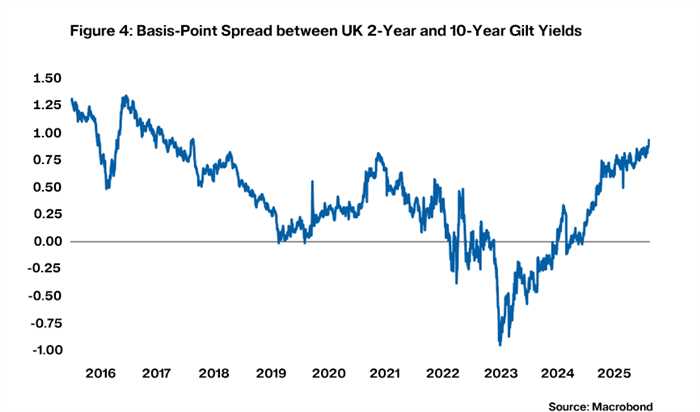
This may be supported by changes in bond yields, with the ‘2s-10s’ (spread between 10-year and 2-year gilt yields) now reaching its highest level since February 2018. Back then it was due to expectations for interest-rate hikes rapidly dissipating in the aftermath of Brexit, before being compounded by Covid lockdowns. Now, the cause is more the opposite – it’s traders seeing there being not many more interest rate cuts in the short-term, whilst simultaneously expecting more rises in the medium and longer terms.

-

Sentiment trumps statistics for US rates markets

As I’m sure readers are all aware, January 3 started the year with the shocking news that the US military’s Delta Force had forcibly extracted Venezuelan President Nicolás Maduro, an event which very much set the tone for a risk-off January dominated by geopolitics. Oil prices did initially dip on the prospect of greater global supply, which would help relieve inflationary pressure globally, but this quickly petered out as traders recognised that it could potentially take years to bring Venezuelan production back to a meaningful level, if it even ever happens. Venezuela’s natural oil reserves tend to be dense, heavy crude. This, coupled with the cost of rejuvenating the aged oil infrastructure, puts the break-even cost of extraction at $80 per barrel according to one estimate, whilst US President Donald Trump is reportedly aiming to push Brent crude prices down to $50 per barrel.

The US intervention in Venezuela didn’t just ripple across oil markets however, it also raised fears of wider US military intervention elsewhere. Throughout January we saw the US threaten strikes against Colombia , Cuba, Mexico, Iran (multiple times) and perhaps most astoundingly Denmark (via Greenland), a fellow NATO-member. Naturally, defence stocks rallied on the expectation of billions more dollars for the military-industrial complex, but where would all that money come from? Trump exclaimed via Truth Social that an extra $600bn for the Department of War would be raised via trade tariffs (reminder: a sales tax on US businesses and consumers) whilst still leaving enough fiscal headroom to pay a dividend out to “middle income patriots”. Even by President Trump’s own self-proclaimed statistics, it’s difficult to make the numbers add-up. He claims that tariffs are generating $300bn of revenue per annum, but that still leaves a big shortfall to somehow be made up even if you ignore spending on other items. This suggests more Treasury bonds may be required, putting upwards pressure on yields and interest rates.

It wasn’t just international politics roiling markets, January 12 also brought the revelation from Jerome Powell, Chairman of the Federal Reserve, that the US government had opened a criminal investigation into testimony he presented to Congress last June regarding the renovation of the Federal Reserve building. Chair Powell claimed that the “unprecedented action” is an attempt to reduce the central bank’s independence, with President Donald Trump having repeatedly criticised him for not cutting interest rates quickly enough. That being said, the market reaction was muted, with only an extra 1bps of cuts being priced in over the next 12 months, as there’s currently only one MAGA dove (Stephen Miran) on the Federal Open Market Committee (FOMC), meaning that even if Mr Powell were ousted and Fed Governor Lisa Cook fired, that would still only be three out of 12 voters politically-aligned with President Trump. 

All of that takes us to the latest Federal Reserve interest rate decision on Jan 28. The resultant hold of the Target Rate Upper Bound at 3.75% was almost entirely priced-in, with swaps traders giving merely a 2.5% chance of a cut. Two members of the FOMC did actually vote to reduce interest rates,  however the official statement excluded the line “downside risks to employment rose in recent months”, with Chairman Jerome Powell saying the Fed would take its time to assess new data. This statement was further supported by data on February 5 showing that businesses announced the largest number of January job cuts since the Great Recession in 2009!

With so many factors at play, both in terms of data and sentiment, it isn’t rare to find people with strong opinions on what the Federal Reserve should be doing next, however not everybody is a professional trader able to express their views by buying or selling swaps throughout the day. What they can do instead is use betting websites to express their opinions, and recent data from Polymarket shows us exactly that – what the average person is more inclined to believe. Polymarket data currently shows users see a 23% chance of two Fed cuts in 2026, but a 26% chance of three cuts. Four cuts is only seen as 16% likely, with five cuts placed at only 7% perceived probability, suggesting a general dismissal of political pressure on the Federal Reserve. For context, five cuts is seen as similar a likelihood as the US invading Greenland in 2026 (8.0%), whilst the chances of Donald Trump standing for a 3rd term in the next presidential election is seen as merely 3.7%. That’s apparently nearly half as likely (7.0%) as the US government confirming the existence of aliens this year!

Dutch pension planning throws a spanner in the works for Eurozone rates markets 

The eurozone similarly had its latest central-bank rate decision on February 5, with the outcome also being for a hold of the deposit facility rate at 2.0%, albeit without much of a surprise. The markets still don’t see any further interest rate cuts there, with a cut in 2026 given merely 30% probability and the weighted-expectations for the December meeting also being marginally in favour of a hike (2.9% probability). 

There is however a bit more excitement in the (you guessed it…) bond markets. This year the Eurozone nations are expected to issue €1.4trn of sovereign debt (c.9% of GDP). At the same time, the European Central Bank (ECB) plans to reduce holdings of Eurozone government bonds by €400bn. Factor in the existing debt that is due to mature and the end result is nearly €900bn of bonds that governments must find new buyers for, considerably more than in any previous year.

This is where pension funds come in to the mix. They collectively own roughly 10% of all long-term Eurozone sovereign bonds, with the Dutch pension system alone accounting for 2/3 of those holdings. Dutch pensions historically were of the “defined-benefit” type, making long-term government bonds an attractive investment due to the almost-guaranteed regular coupon payments, virtually risk-free if there’s little need to sell mid-term. It makes being a Dutch pension-fund manager almost sound easy! That was until recently when reform of Dutch pension regulations pushed defined-benefit schemes out the door in favour of defined-contribution schemes, making low-yield but low-risk long-term government bonds no longer an attractive proposition compared to riskier assets such as equities. 

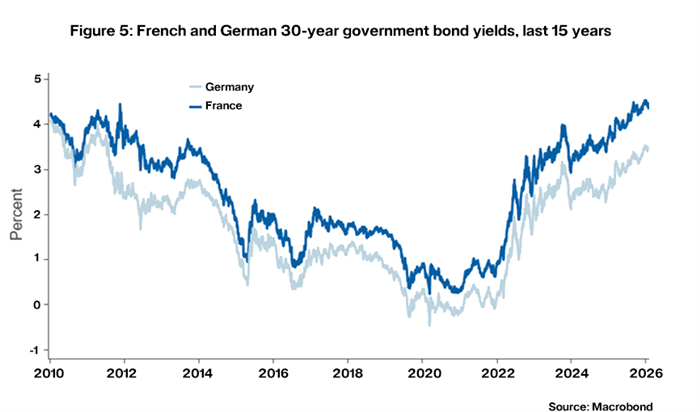
The Dutch central bank recently forecast that this could cause sales of €100bn-150bn of sovereign bonds with maturities over 25 years – a very significant portion of the c.€900bn of such bonds still outstanding. Such a transition is expected to take two years, however the loss of demand could still have a sizeable impact on valuations, pushing up bond yields and making the issuance of new long-term debt considerably more expensive for governments. That spells particularly bad news for those countries, such as France and Germany, whose bond-yields are already at their highest levels since the Eurozone Crisis of 2011-12.

-

This will pose an unenviable problem for finance ministers: accept the higher yields, or issue relatively more bonds with shorter-dated maturities? The shorter-dated bonds will offer lower yields and hence interest costs, however they must be refinanced sooner making the government finances more susceptible to interest rate risk in the meantime.

Tom Barker, Handelsbanken Markets

Important information

All the opinions, forecasts, estimations and comparable information expressed in this email are the subjective views of the author and have not been independently verified or corroborated. Accordingly it is not and does not purport to be objective research. Handelsbanken plc does not accept liability to any person who relies on the content of this email and accompanying attachments, if any. Handelsbanken plc makes no guarantee, representation or warranty and accepts no responsibility or liability as to the completeness of the information contained in this email and accompanying attachments and none of Handelsbanken plc’s officers, directors, or employees makes any guarantee, representation or warranty, nor does any such person accept any responsibility or liability for any loss of profit, indirect or other consequential losses or other economic losses suffered by any person arising from reliance upon any information, statement or opinion contained in this email and any accompanying attachments (whether such losses are caused by the negligence of such person or otherwise). Handelsbanken plc and/or its directors, officers or employees may have, or have had interests in, and may at any time make purchases and/or sales as principal or agent or may provide or have provided corporate finance and or other advice or financial services to the relevant companies. All information in this material is expressed as at the date of this email and is subject to changes at any time without prior notice or other publication of such changes. Past performance is not necessarily indicative of future results. This e-mail may be confidential. If you have received it in error please note that you may not copy or use the contents or attachments in any way. Please destroy this entire message and notify the sender. E-mails are not secure and Handelsbanken plc cannot accept responsibility if they are intercepted, diverted or corrupted or contain viruses. Handelsbanken Capital Markets is a trading name of Handelsbanken plc, which is incorporated in England and Wales with company number 11305395. Registered office: 25 Basinghall Street, London, EC2V 5HA, UK. Handelsbanken plc is authorised by the Prudential Regulation Authority and regulated by the Financial Conduct Authority and the Prudential Regulation Authority. Financial Services Register number 806852. Handelsbanken Capital Markets is the trading name of both: (i) Handelsbanken plc; and (ii) Svenska Handelsbanken (AB) publ, which is incorporated in Sweden with limited liability. Registered in Sweden No. 502007 7862 Head office in Stockholm. Authorised by the Swedish Financial Supervisory Authority (Finansinspektionen). Handelsbanken plc is a wholly-owned subsidiary of Svenska Handelsbanken AB (publ).