Woman working on a tablet

Summer holidays? Must be busy season then

The economist's corner

Geopolitics continues to be the main driver of UK financial markets

Since the start of the Iran war, we have been emphasising the pattern of geopolitics being the primary driver of movements in UK financial markets, with domestic political risk playing a secondary role. Regular readers may remember us talking about another situation like this in the last Rate Wrap. 

After initial optimism about the US-Iran ceasefire led to a positive reaction in financial and energy markets towards the latter part of June, the resumption of hostilities between the warring parties in July saw ship movements in the Strait of Hormuz collapse (see Figure 1). Inevitably, what followed was oil prices again jumping up across the futures curve, which then hit sovereign debt markets as renewed concerns about global inflation pressures came to the fore. 
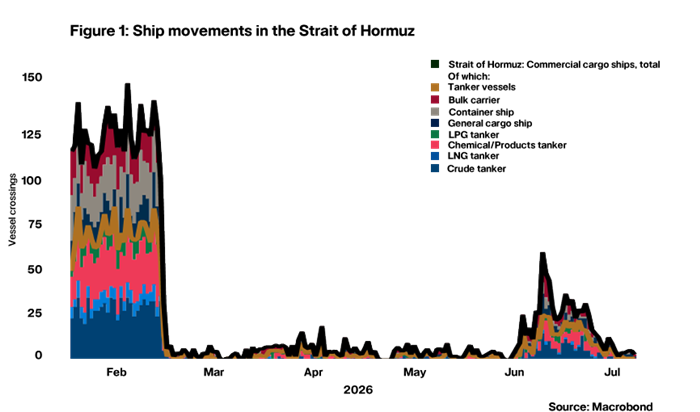
Fig. 1

And domestic politics continues to exacerbate issues…
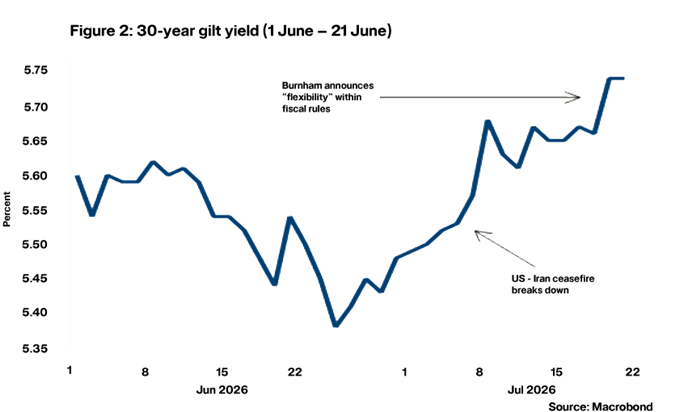
Fig. 2

The pressure on gilt yields came just in advance of Andy Burnham entering Number 10 Downing Street, giving the new prime minister something of a fiscal headache. And, in addition to worries surrounding geopolitical risk, it is notable that the gilt market has already expressed some concerns about the new government’s potential domestic agenda. Mr Burnham’s pronouncement that he would use “flexibility” within the current fiscal rules led to outsized increases in UK gilt yields, with the 10-year gilt yield breaching the 5% mark on his first day as prime minister. 

While the subsequent surprise appointment of John Healey as chancellor was reasonably well received by financial markets, the gilt market has now already sent a message that it will not tolerate any sign of fiscal slippage by the government. Attention will now naturally turn to how Andy Burnham plans to increase spending in areas such as defence while sticking to his fiscal rules at a time when the gilt market is hardly looking favourable for him. 

Weak labour market will bear down on potential second round effects

What does the current backdrop mean for the rates outlook? The breakdown of the US-Iran ceasefire has effectively meant, as of 22.07, financial markets are pricing in nearly three rate hikes over the next twelve months rather than just the one that was predicted at the beginning of July. This is a natural response to the large increase in oil prices (spot prices are at $95 a barrel at the time of writing), but it is perhaps a slight overreaction given the UK labour market continues to show weakness, especially in the private sector. It is striking, in particular, just how much employment has fallen in the retail and hospitality sectors over the past year (see Figure 3), likely in large part due to increased payroll costs from hikes to employers’ national insurance contributions. This is, of course, a negative macro story but the weak labour market reduces the chance of significant second-round effects taking hold after the upcoming inflation spike, as employees are simply not in a strong position to demand high pay increases.
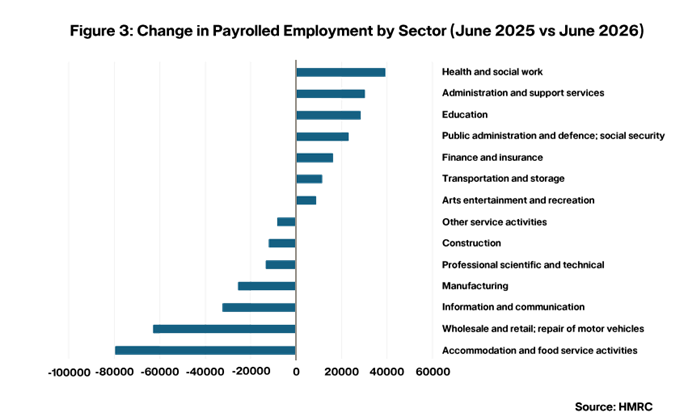
Fig. 3

“Wait and see” approach likely to continue

Both the geopolitical and domestic political situation remains labile and August could very plausibly bring either upside or downside surprises. This makes for an especially challenging environment to produce forecasts and, for now, we will not be making any updates until the next Global Macro Forecast in September. 

What seems pretty clear, however, is that there is still probably not enough evidence in the data yet for the Bank of England’s Monetary Policy Committee to hike rates at the interest rate meeting on July 30. Despite the recent rise in oil prices, the Bank of England will likely want to continue its “wait and see” approach given the uncertainties on both the geopolitical and domestic front, as well as continued signs of weakness in the labour market.  

Daniel Mahoney, Senior Economist, UK
A view from the dealing desk

July has been a month of volatility, and the consistent flurry of news stories has caused a constant changing of market expectations, so as Daniel said, no change there! At time of writing (July 22) we are looking ahead to a series of central bank meetings under a cloud of uncertainty, with no interest rate changes expected this month in the UK, USA or Eurozone on July 30, 29 and 23 respectively, however for each the future path is far from clear. 

The ceasefire collapses…

Perhaps most important for traders has been the end to the tentative US-Iran ceasefire brought about by the signing of the Memorandum of Understanding last month, with President Trump declaring as early as July 8 that the ceasefire was “over” following US strikes on more than 80 Iranian sites in response to attacks on commercial vessels transiting the Strait of Hormuz. Strikes continued to be exchanged throughout the following weeks, prompting a resumption of blockades by both parties, with President Trump remarking on social media that the strait “will remain OPEN, with or without Iran”. Initially a 20% toll on all cargo ships was announced by the US, which would add around $32m to the cost of a single fully-loaded, very large crude carrier at the prevailing oil price, far exceeding the $2m per ship that Iran had previously proposed charging. Markets reacted predictably by pricing-in further bets on a July interest rate hike in the USA, perhaps as early as September, and a second hike in H1 2027, whilst Treasury yields rose particularly in the shorter-dated tenors, with two-year Treasury Notes staying above 4.25%. 

Whilst the toll announcement was reversed merely two days later after pressure from US allies the relief was short-lived, with news on July 20 that the Houthis, an Iran-backed Yemeni rebel group, announced their own imposition of a maritime blockade, this time of Saudia Arabia and in the Red Sea, in response to the Saudis’ alleged siege of Sana’a, Yemen’s capital. Saudi Arabia currently uses the Red Sea for the majority of its exports, particularly having diverted oil flows through there  following the outbreak of the war and Iran’s effective closure of Hormuz. Those exports, which rose to a record 4.19m barrels a day last month, have helped limit the disruption to global supplies, but the route remains fragile as it exposes tankers to the Houthi militants who have previously attacked ships in the Red Sea. 

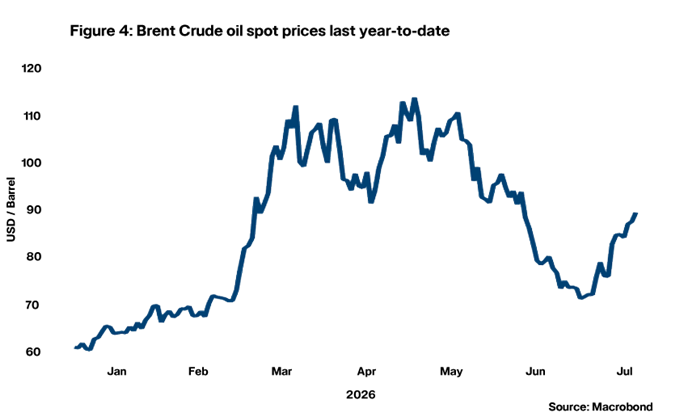
Overall the pressure has continued to rise on energy prices, with Brent crude oil now approaching $100 per barrel and UK natural gas spot prices back over $20 per MMBtu, very close to the high of $20.61 reached in mid-March.

Fig. 4

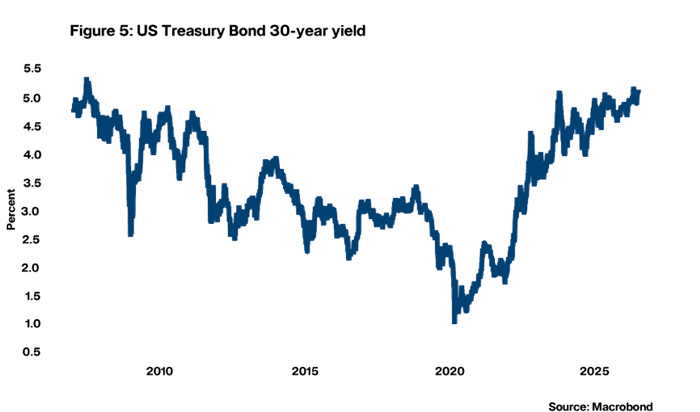
Particularly of concern is that US 30-year Treasury yields have now been trading consistently above 5% for 27 days, the longest period since during the Global Financial Crisis in 2007, and making any new borrowing even more expensive to service. Currently the markets are looking at 54.6bps of hikes by the Federal Reserve over the coming 12-month period, with that first hike coming in October.  However this may well be subject to more upwards pressure in the coming weeks, particularly should oil prices breach the psychological $100pb level.

Fig. 5

Promises of fiscal flexibility rather than febrility

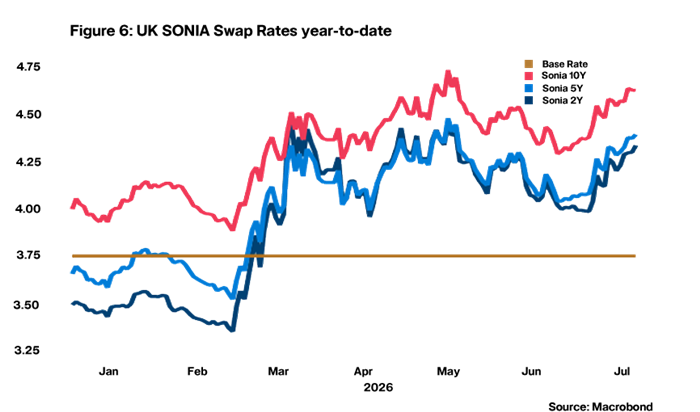
President Donald Trump’s announcement of the planned 20% toll on the Strait of Hormuz on Jul 14 coincided with political speculation at home reaching fever pitch with speculation over who would be Andy Burnham’s pick to be the new Chancellor of the Exchequer. Gilt yields had steadily climbed to levels not seen since mid-May at the height of the US-Iran conflict, whilst swap rates also peaked that same day, with 2-5 year tenors over 4.30% and 10-year swaps trading as high as 4.62%.

Of course we then had a change of Prime Minister on July 20, and whilst 10-year gilt yields had risen above 5% due to Andy Burnham’s initial speech on taking office, pledging to find “flexibility” within the existing fiscal constraints, the appointment of John Healey as chancellor reassured markets sufficiently to see gilt yields open flat the following day and then continuing to trade sideways. Whilst little detail has yet been announced on policy, it’s suspected that given Healey’s resignation as defence secretary in Sir Keir Starmer’s government over insufficient funding for the British armed forces, his appointment heavily implies further investment for the military. There is an argument to be made that investment in the military now as a deterrent would be cheaper than emergency borrowing to fight a future war, but whether bond traders agree depends on as-yet unknown policy. 

Rate expectations have moved upwards

For the UK, the markets currently see merely a 6% chance of the MPC deciding to hike base rate this month, perhaps partly due to inflation falling to 2.6% in June and a little lower than expectations of 2.7%. That downwards inflation trend may not continue however due to the recent rise in energy prices and should they remain at higher levels will support the first 25bps hike expected by November. A second hike to 4.25% is presently seen coming as early as March, and there’s potentially a third hike by next summer, with a total of 68.9bps of hikes priced in for the coming 12-month period - quite a change from last month’s expectations of only one full 25bps rate hike! 

Fig. 6

It’s worth noting that the spread between 2-5 year gilt yields has widened somewhat, with the former trading a shade under 4.40% whilst the latter is closer to 4.60%. The same is true for swap rates, although the 2-5 spread there is still fairly narrow with both currently trading between 4.35 – 4.40%, indicating that after these initial two-three base rate hikes the markets are then pricing for base rate to remain flat in the medium-term. Even the 10-year swap rates are holding steady on the topside of 4.60%, indicating not much more of an uplift in the longer-term. Personally I think it’s very optimistic to believe that nothing major will happen beyond the initial 12-month horizon, and instead is more likely due to uncertainty amongst traders. Swap rates do after all only represent the market’s opinion, not market fact! 

Tom Barker, Handelsbanken Markets

Important information

All the opinions, forecasts, estimations and comparable information expressed in this email are the subjective views of the author and have not been independently verified or corroborated. Accordingly it is not and does not purport to be objective research. Handelsbanken plc does not accept liability to any person who relies on the content of this email and accompanying attachments, if any. Handelsbanken plc makes no guarantee, representation or warranty and accepts no responsibility or liability as to the completeness of the information contained in this email and accompanying attachments and none of Handelsbanken plc’s officers, directors, or employees makes any guarantee, representation or warranty, nor does any such person accept any responsibility or liability for any loss of profit, indirect or other consequential losses or other economic losses suffered by any person arising from reliance upon any information, statement or opinion contained in this email and any accompanying attachments (whether such losses are caused by the negligence of such person or otherwise). Handelsbanken plc and/or its directors, officers or employees may have, or have had interests in, and may at any time make purchases and/or sales as principal or agent or may provide or have provided corporate finance and or other advice or financial services to the relevant companies. All information in this material is expressed as at the date of this email and is subject to changes at any time without prior notice or other publication of such changes. Past performance is not necessarily indicative of future results. This e-mail may be confidential. If you have received it in error please note that you may not copy or use the contents or attachments in any way. Please destroy this entire message and notify the sender. E-mails are not secure and Handelsbanken plc cannot accept responsibility if they are intercepted, diverted or corrupted or contain viruses. Handelsbanken Capital Markets is a trading name of Handelsbanken plc, which is incorporated in England and Wales with company number 11305395. Registered office: 25 Basinghall Street, London, EC2V 5HA, UK. Handelsbanken plc is authorised by the Prudential Regulation Authority and regulated by the Financial Conduct Authority and the Prudential Regulation Authority. Financial Services Register number 806852. Handelsbanken Capital Markets is the trading name of both: (i) Handelsbanken plc; and (ii) Svenska Handelsbanken (AB) publ, which is incorporated in Sweden with limited liability. Registered in Sweden No. 502007 7862 Head office in Stockholm. Authorised by the Swedish Financial Supervisory Authority (Finansinspektionen). Handelsbanken plc is a wholly-owned subsidiary of Svenska Handelsbanken AB (publ).