Rates graphic

Markets can no longer “look through” supply shocks

The economist's corner

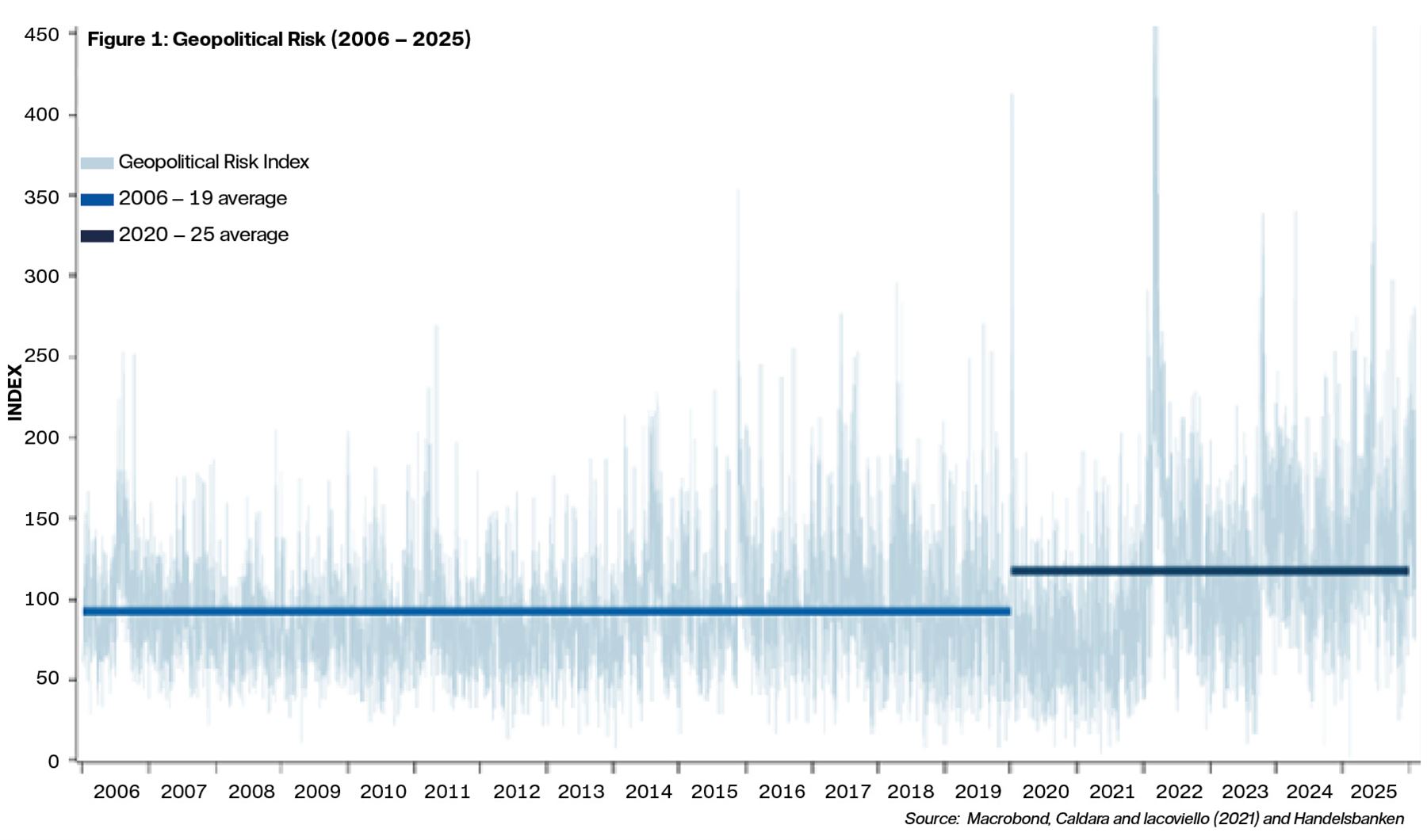
It is difficult to remember now, but only a few weeks ago it was widely anticipated that there would be some further loosening of monetary policy in the UK. The labour market remained relatively weak, wage growth was showing some continued signs of easing and growth prospects were modest – all of which pointed to a few rate cuts this year. We were, however, warning clients Opens in a new window that the UK’s domestic political situation as well as an increase in geopolitical risk meant there was a chance interest rates could rise. Trends in geopolitical risk have for some time indicated that we should expect more numerous and severe supply shocks in future (see Figure 1), and events in March have seen the upside risks to interest rates materialise.
-

We can already observe from March’s UK PMI reading that the energy supply shock arising from the war in Iran will have a significant stagflationary impact on the UK economy. The OECD has also projected that UK inflation will now be double the Bank of England's target this year at 4%. However, the exact magnitude of the shock is still very difficult to say at this stage given all the uncertainties.

I am not an expert in geopolitics and there is already a lot of speculation about different scenarios – so instead let’s reflect on what we can learn from energy price shocks in financial history, in particular those during the Gulf War in the early 1990s and the more recent invasion of Ukraine in 2022. 

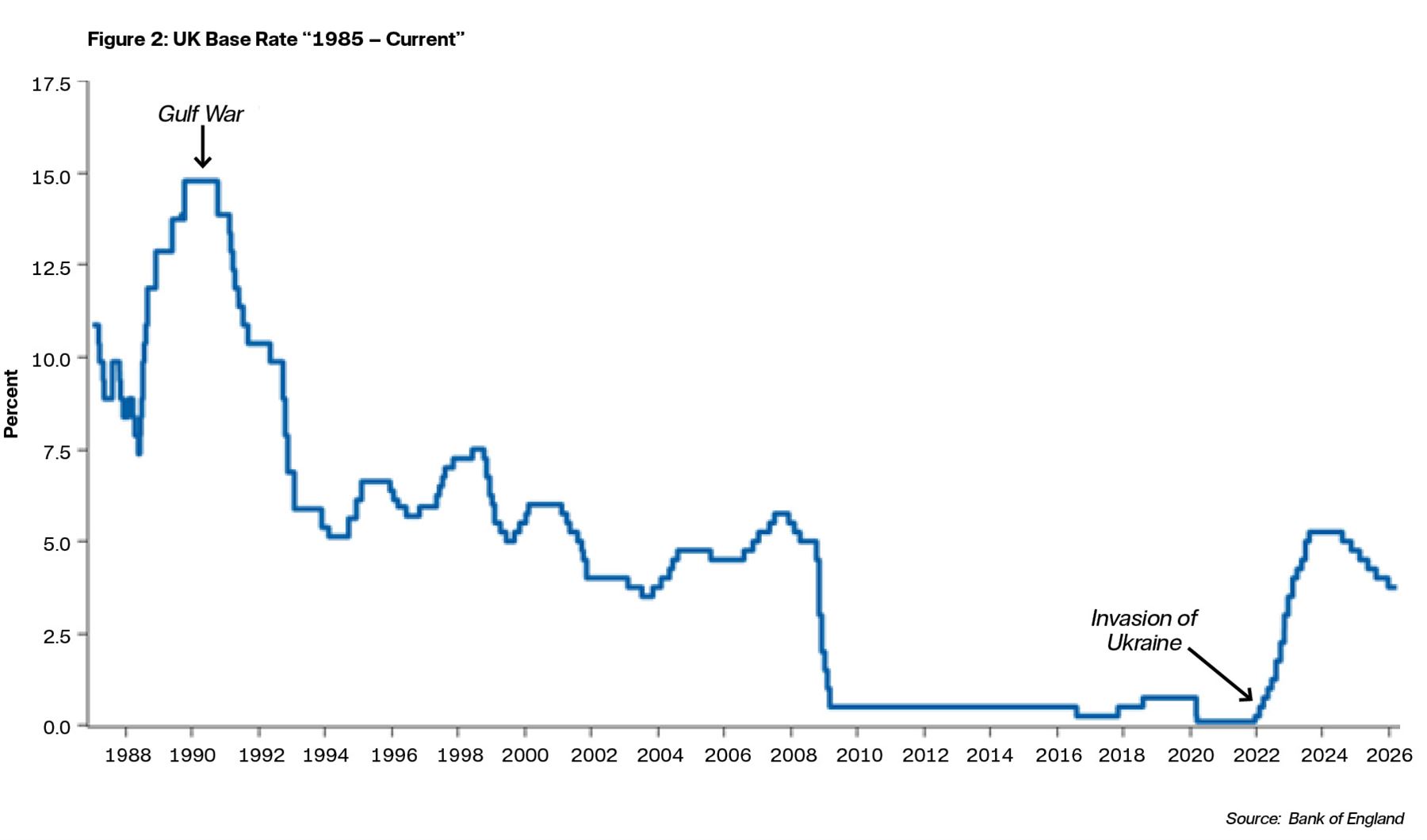
When the Gulf War energy price shock hit the UK, interest rates had already previously risen dramatically in response to overheating domestic conditions during the so-called “Lawson Boom”, which is a period that I recently discussed at an event Opens in a new window with former Bank of England Governor Lord Mervyn King, and former Chief Advisor to the Treasury, Lord Terry Burns. Moreover, crucially the UK at the time was a net exporter of energy, so the increase in oil prices led to an improvement in the UK’s balance of payments and had the effect of prompting a deflationary strengthening of sterling. This backdrop allowed an interest rate cutting cycle to begin even during the spike in oil prices.

When looking at the invasion of Ukraine, the macro backdrop was almost the reverse of what preceded the Gulf War. The UK went into this energy price supply shock with ultra-low interest rates and a recently-concluded quantitative easing programme that contributed to excess demand in the economy. This compounded the inflation arising from the supply shocks due to Covid and Russia’s invasion of Ukraine which, of course, precipitated an aggressive increase in interest rates from the Bank of England and other central banks across the Western world. 
-

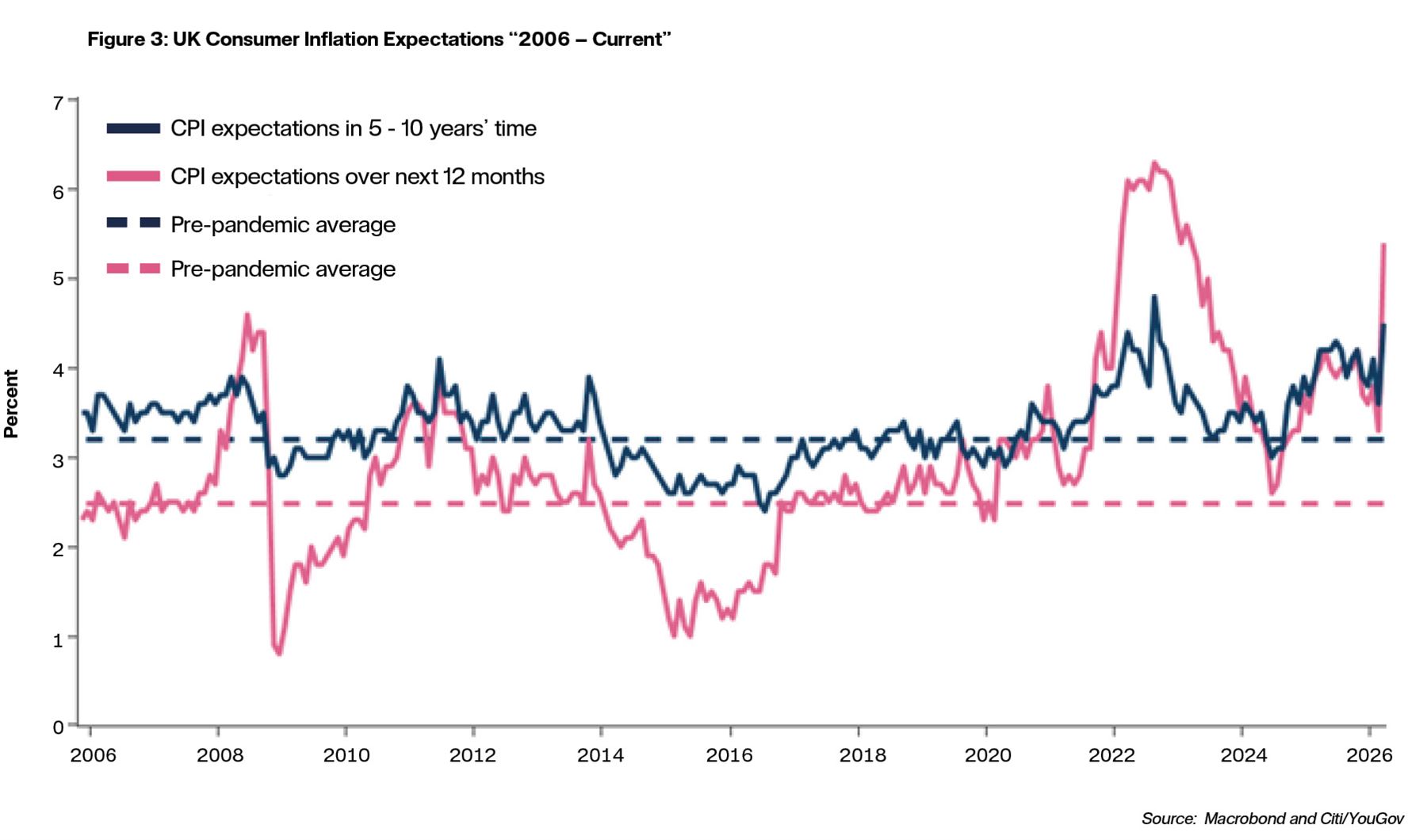
The current situation with respect to monetary policy is somewhere between these two case studies. Monetary policy has been loosened over the past 18 months or so, but we are likely entering into the current supply shock with interest rates that are somewhat higher than neutral levels. Will this allow the Bank of England to “look through” this shock? Most likely not. Even though we go into this period with a headline rate of inflation lower than what was the case during the Gulf War and the Ukraine invasion (3% vs 7% and 6%, respectively), CPI is still notably above the Bank of England’s target, and consumer inflation expectations, both short-term and long-term, have seen an enormous jump in March (see Figure 3).
-

The MPC’s latest unanimous decision to hold rates at 3.75% shows just how seriously rate-setters are taking this supply shock, and following the outbreak of war in Iran, financial markets have gone from pricing two rate cuts this year to several rate hikes. This new era of higher geopolitical risk may mean central banks’ traditional view of ‘looking through’ ie essentially overlooking, supply shocks, is a thing of the past. We continue to closely monitor the situation with a view to revising our forecasts over the coming weeks. Our next Global Macro Forecast report is out on 28 April.

Daniel Mahoney, UK Economist
A view from the dealing desk

Pre-Middle East war, we had a relatively calm path for interest rates in the UK, with markets pricing in two more cuts for 2026. As Daniel hinted above, that’s now been flipped on its head, and the narrative has shifted to rate hikes instead. 

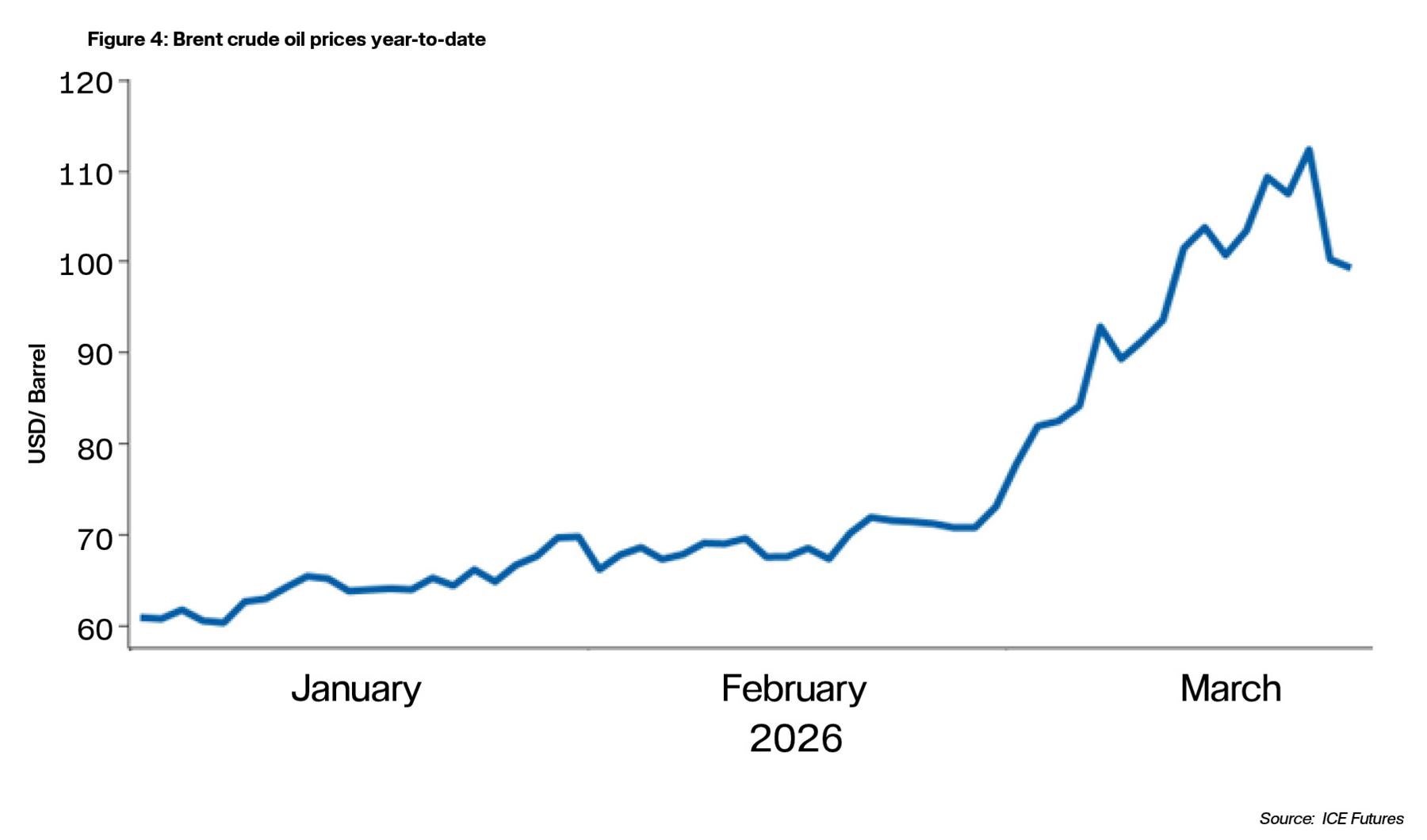
But how have we got to this point? When we look at the drastic shift we have seen in expectations, a key starting point is looking at oil prices. Looking at year-to-date, Brent crude prices started off the year around $60 a barrel, and are now trading around $100 a barrel. Parallels are being drawn to the 2022 Ukraine energy price spike, as Daniel has discussed above, and the key concern is the longevity and magnitude of oil prices remaining anchored higher. The longer we see higher oil prices, the bigger the expected impact on inflation in the short and medium-term.

-

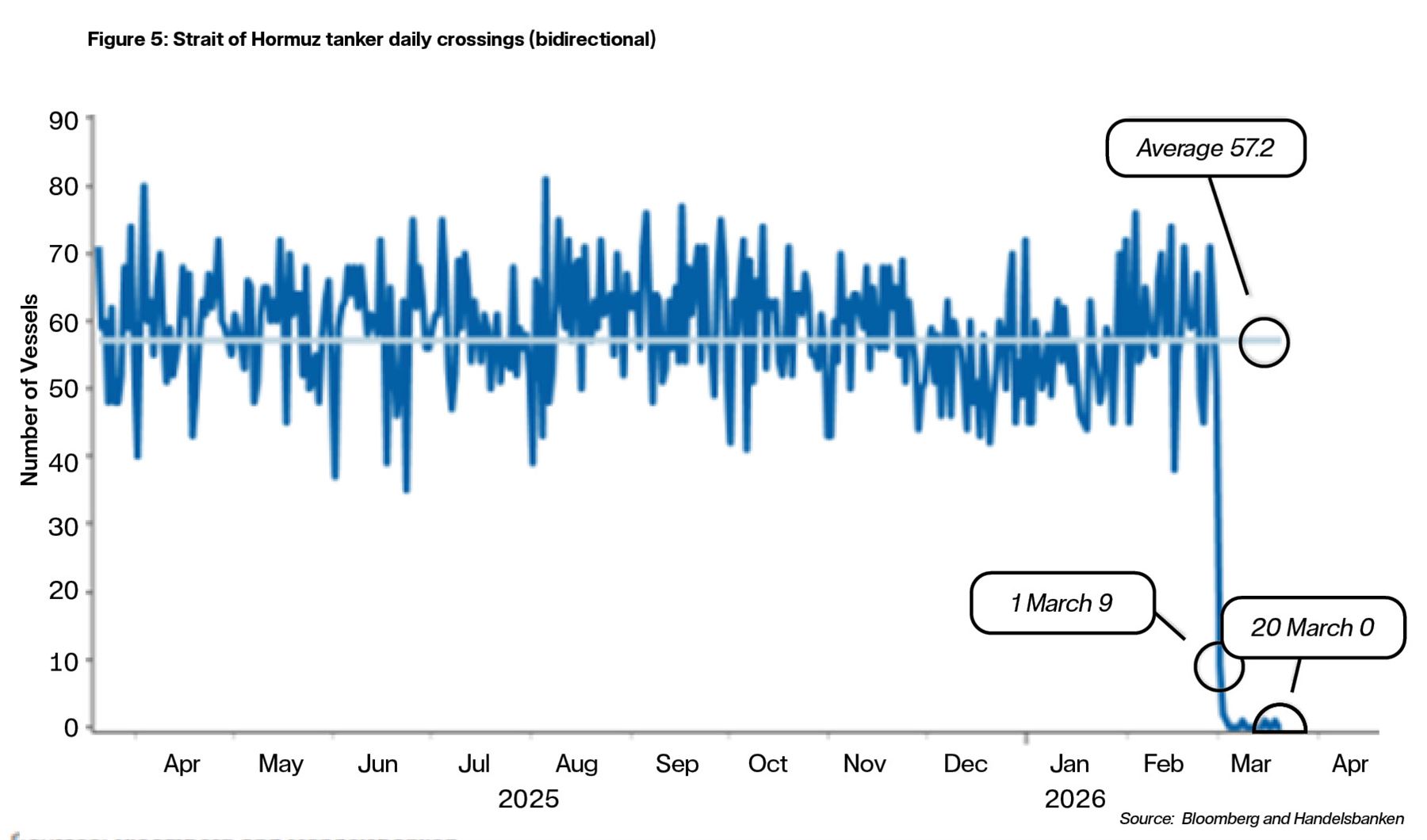
A key data point that markets are looking to is the number of vessels transiting the Strait of Hormuz on a daily basis, and the chart below shows how dramatic the disruption has been. At the end of February we had roughly 90 vessels crossing the strait each day, and since the war began there has been either one or none. This means the strait has been effectively closed, and it’s not as straightforward as “reopening” it again. There are around 2,000 ships stranded in the Persian Gulf (Source: Bloomberg March 2026), and if you combine maritime traffic, restarting idle facilities and repairing damaged ones, it’s not as simple as “supply will go back to February levels overnight”. This feeds into oil and gas pricing, and a risk premium is expected to persist as a result.

-

Interestingly, oil prices are arguably under-pricing this, and research by our senior economist in Sweden, Magnus Lindskog Opens in a new window, explores this further, finding that a 50% closure of the strait corresponds to an oil price close to $100, compared to $165 for a full closure. This suggests that oil prices are optimistic, compared to the interest rate pricing which is arguably pessimistic – either way, there is a disconnect between oil prices and interest rate expectations . 

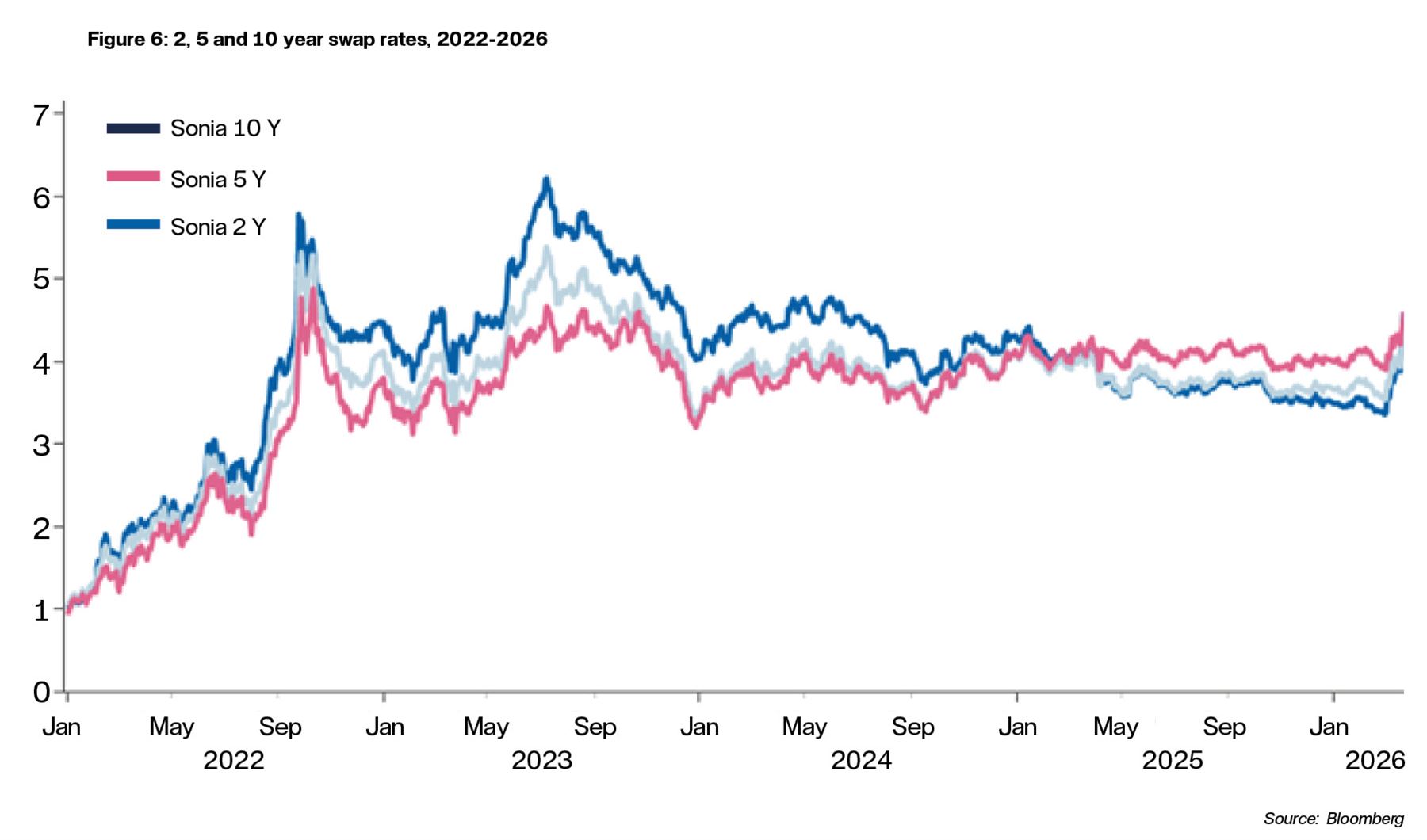
The Bank of England MPC meeting on 19 March saw base rate held at 3.75%, but opened the door to rate hikes, citing members stand “ready to act” against inflation. It was expected that we would see a 7-2 vote to hold (two votes to cut), but instead it was a unanimous vote to hold. The surprise was even the most dovish of committee members like Swati Dhingra expressed concern that a hike may be needed to control inflation. We saw a repricing of expectations as a result, with the 2-year swap rate jumping over 40bps after the meeting, and the 2-year gilt yield going up 30bps, which was the highest seen since January 2025 when the bond market had a wobble around the UK government’s fiscal position. 

Market jitters saw drastic repricing, with swaps traders pricing four rate hikes at one point. This has since been unwound, but if we compare where we were at the end of February, Tom wrote in the previous Rate Wrap, two rate cuts were priced in to bring base rate to 3.25%. At time of writing (25/03/2026) there are around 60bps of hikes priced in, which equates to two rate hikes fully priced in, and a third priced in by some swaps traders. The 2-year swap rate is now trading at a premium above the 5-year swap rate, which reflects market pricing of rate hikes in the short-end of the curve. 

-

In terms of wider asset class movements, it’s worth noting that we have seen a flight from riskier assets such as equities, bonds and metals. Typically equities and bonds tend to move in opposite directions, and so the “sell-everything” story shows a supply-side shock and concerns around stagflation, as markets price in expectations that policymakers will take a proactive approach to monetary policy to steer the economy. 

We saw markets sigh in relief after Trump’s Truth Social post which said that negotiations had started with Iran, hinting that a resolution for the war could be on its way. He announced a 5-day pause to attacks, but optimism over de-escalation dwindled as Iran continued attacks on US bases in the Gulf and Israel traded fire with Tehran. The Arab states have also expressed some scepticism that the US is looking for a peace deal. 

Given it’s a fast-moving situation, news flows are vital for markets, and to summarise, headline-driven trading continues to drive market direction instead of economic fundamentals. 

Jasmine Crabb, Handelsbanken Markets

Important information

All the opinions, forecasts, estimations and comparable information expressed in this email are the subjective views of the author and have not been independently verified or corroborated. Accordingly it is not and does not purport to be objective research. Handelsbanken plc does not accept liability to any person who relies on the content of this email and accompanying attachments, if any. Handelsbanken plc makes no guarantee, representation or warranty and accepts no responsibility or liability as to the completeness of the information contained in this email and accompanying attachments and none of Handelsbanken plc’s officers, directors, or employees makes any guarantee, representation or warranty, nor does any such person accept any responsibility or liability for any loss of profit, indirect or other consequential losses or other economic losses suffered by any person arising from reliance upon any information, statement or opinion contained in this email and any accompanying attachments (whether such losses are caused by the negligence of such person or otherwise). Handelsbanken plc and/or its directors, officers or employees may have, or have had interests in, and may at any time make purchases and/or sales as principal or agent or may provide or have provided corporate finance and or other advice or financial services to the relevant companies. All information in this material is expressed as at the date of this email and is subject to changes at any time without prior notice or other publication of such changes. Past performance is not necessarily indicative of future results. This e-mail may be confidential. If you have received it in error please note that you may not copy or use the contents or attachments in any way. Please destroy this entire message and notify the sender. E-mails are not secure and Handelsbanken plc cannot accept responsibility if they are intercepted, diverted or corrupted or contain viruses. Handelsbanken Capital Markets is a trading name of Handelsbanken plc, which is incorporated in England and Wales with company number 11305395. Registered office: 25 Basinghall Street, London, EC2V 5HA, UK. Handelsbanken plc is authorised by the Prudential Regulation Authority and regulated by the Financial Conduct Authority and the Prudential Regulation Authority. Financial Services Register number 806852. Handelsbanken Capital Markets is the trading name of both: (i) Handelsbanken plc; and (ii) Svenska Handelsbanken (AB) publ, which is incorporated in Sweden with limited liability. Registered in Sweden No. 502007 7862 Head office in Stockholm. Authorised by the Swedish Financial Supervisory Authority (Finansinspektionen). Handelsbanken plc is a wholly-owned subsidiary of Svenska Handelsbanken AB (publ).