Pound coin

UK takes centre stage in November

The economist's corner

It was some time ago now but let’s firstly reflect on November’s MPC decision. The vote was split down the middle with Governor Bailey tipping the balance in favour of holding rates rather than the committee voting to cut rates by 0.25pp. The committee is clearly beginning to move in a more dovish direction; for example, the guidance of, “a gradual and careful approach to further withdrawal of monetary policy remains appropriate”  has been replaced by, “if disinflation continues, the bank rate is likely to continue on a gradual downward path”. But why was the committee not able to agree on a cut to interest rates?

Inflation expectations were cited by a majority of the MPC members who voted to hold rates. As discussed in the previous Rate Wrap, the base-case view of financial markets (the inflation swaps market) is sanguine with respect to longer-term inflation in the UK, but this is not the whole story. Inflation risk has been contributing to the term premia in the longer end of the gilt market and UK consumer inflation expectations appear to be high at the moment. Longer-term consumer inflation expectations are, of course, more influenced by temporary short-term spikes in inflation and by high food prices. Yet, regardless of what drives consumer expectations, they matter given 60% of UK GDP is made up of household spending decisions. 

There are also three key reasons why there is a higher risk of raised expectations leading to higher realised inflation in the post-pandemic era: 

  • There has been a very significant spike in inflation in recent times, which may serve to make anchoring longer-term consumer expectations more difficult now and in the future;
  • UK inflation is currently sitting above the level at which the correlation between expectations and realised inflation strengthens;
  • The service sector’s dominance of the UK economy may render it more prone to second-round effects compared to economies with less of a concentration of services such as the eurozone. 

If you’re interested, you can read more on this topic in our recently published paper How concerned should we be about elevated consumer inflation expectations? Opens in a new window.

-

Turning to the budget, we were keeping our eyes on three broad macro indicators. First, how much headroom would there be above Chancellor Rachel Reeves’ fiscal target; second, would fiscal consolidation be front-loaded or backloaded; and third, would there be any measures for growth?

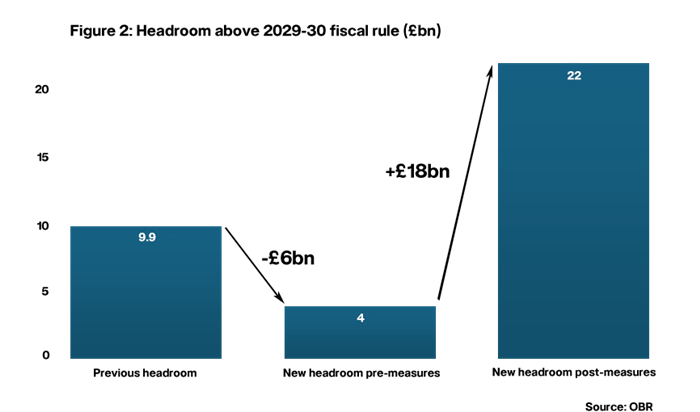
On the first, the OBR was unexpectedly kind to the chancellor. While it downgraded future annual productivity growth forecasts from an average of 1.3% to 1%, the future fiscal impact of this was largely offset by an increase in expected tax revenues arising from earnings growth forecasts being revised up. Pre-measures, Reeves was left with £4bn of headroom to which she added £18bn of measures in the budget. 

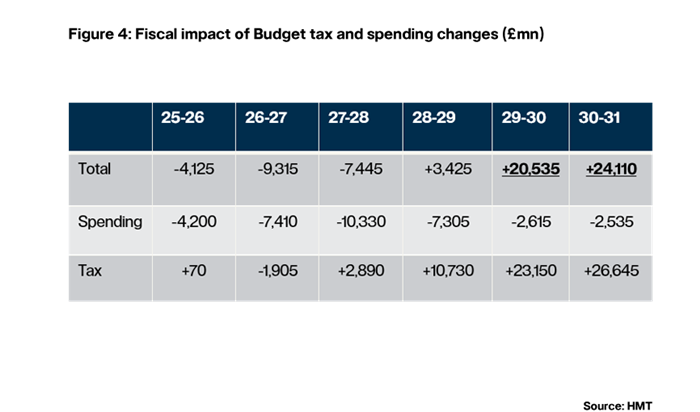
On the second and third metrics, the news was far less market-friendly: the budget increases spending over the next three financial years and backloads tax increases to the end of the decade. And there was very little in the budget to promote growth. It is notable that the OBR has downgraded its growth forecasts for 2026 onwards. Despite this, financial markets reacted relatively well to the budget, perhaps taking comfort from the OBR’s better-than-expected forecast for government finances and the improved headroom above Rachel Reeves’ fiscal target. But fiscal sustainability worries will no doubt linger: the budget raises borrowing over the next few years, fiscal consolidation somewhat lacks credibility due to it being backloaded, and inflation persistence remains a concern. 
-
-
-

In terms of what the budget means for the rate pathway, the truth is — not a huge amount. Yes, a December rate cut is now almost a dead cert, particularly as the measures on energy costs will lower inflation next year, but it is notable that an overall fiscal loosening over the next three financial years and a backloading of fiscal consolidation will do nothing to help the Bank of England cut rates further. After a cut in December, the Bank of England will be very cautious with respect to continuing the rate cutting cycle.

Daniel Mahoney, UK Economist
A view from the dealing desk

November has seen the UK in the spotlight, with the Bank of England’s MPC meeting at the start of this month, and the widely-anticipated UK budget unveiled. Likewise, the US has finally seen the end of the government shutdown and the resumption of economic data releases. 

Dovish pivot from the Bank of England 

The start of November saw the MPC vote to keep base rate at 4.00%, as markets and economists alike expected. However, as Daniel discusses above, the voting was split, with a 5-4 majority to hold rates, with the minority four voters calling for a 25bp cut. This was seen as a prudent decision by many, given that inflation still remains almost double the 2% target. That being said, the language used has shifted to a more dovish stance since the September meeting, and gave a stronger indication that further cuts are to come in this rate cutting cycle. September’s inflation reading was encouraging, undershooting expectations, but it’s only one data point. Swap markets moved to price in around a 70% chance of a December cut off the back of the MPC meeting. However, the wider reaction in the swaps market was muted, with only a 2bp fall seen across the curve, with traders shifting the weighted probability of a cut from February to December instead of a fundamental repricing of the curve. 

As it now stands, at the time of writing (01/12/2025) a December cut to 3.75% is 92% priced in, with the next 25bp cut mostly priced into April’s MPC meeting. There are some calls for a third cut which would take us to 3.25%, but the probability is less than half. 

Budget drama steals the limelight

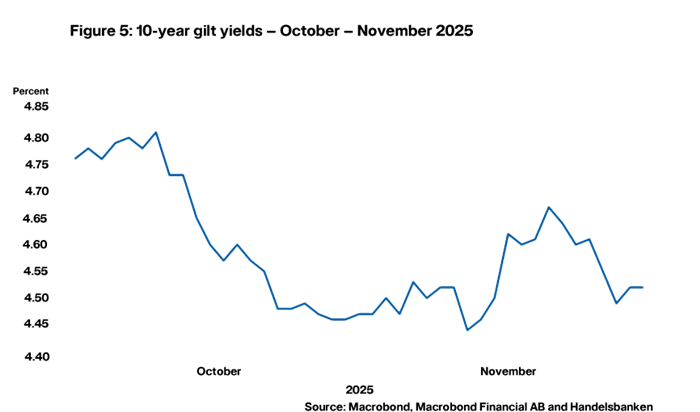
The real showstopper for November was the UK budget, and the impact of the build-up. While the pound and UK assets have been subject to fragility over the past few months, this came to a head mid-month. An article published in the financial press saying that Chancellor Rachel Reeves was considering dropping plans to raise income tax, spooked markets. Throughout October – as Cameron talked about in October’s Rate Wrap – we saw gilt yields and swap rates cool off as the government seemed to plan on raising headroom against its fiscal rules by front-loading tax hikes. This news flipped that narrative on its head.

While raising income tax would effectively break Labour’s manifesto pledge, by doing the opposite it instead gave rise to questions about how the chancellor is going to fill the gap. A wider context around the sustainability of government debt for the longer term is an issue the bond market continues to grapple with, as Dan has written about previously. Noises around an estimated £35bn needed to restore fiscal reserves circulated, and raising income tax would be a robust measure to address this. While an income tax rise would impact economic growth to an extent, the gilt market was comfortable that this would ultimately sufficiently address the fiscal situation for the UK.  

The article suggested that the chancellor had drafted two versions of the budget, with one including an income tax rise, and the other a combination of smaller measures. The article suggested that she was leaning towards the latter. We saw an initial spike in yields, with the 10-year gilt yield up 10 basis points to over 4.5%, and the pound fell on the news. Some of this scaled back after further headlines came out to justify the dropping of income tax rises, and the suggestion of improved forecasts for the UK arose, with headroom estimated to be £15-20bn. The pound and gilt yields steadied, but UK assets as a whole have been subject to volatility throughout November. 

Unprecedentedly on budget day, details of key policies were published in error on the OBR’s website over 40 minutes early. Although these were swiftly taken down, the cat was already out of the bag, and the bond market had reacted. 10-year gilt yields fell 7 basis points, reversing the move 10bps higher before the chancellor even began speaking. The OBR report contained a number of surprises as Daniel has outlined above. The knee-jerk reaction in gilt yields highlights how sensitive the market is to the overall fiscal outlook for the UK, and the pound whipsawed. The FTSE 100 climbed over 0.6% from the day’s lows, and continues to nudge upwards. 

-

Markets have seemingly let the chancellor off quite lightly, and the bond market in particular is fairly comfortable with her approach to fiscal prudence, with the announcement satisfying concerns around control of UK government debt. However, the chancellor now faces the court of public and political opinion as numerous articles circulate surrounding her messaging regarding the state of the UK’s finances in the lead-up to the budget. 

End of longest US government shutdown in history

In the US, we finally saw the end of the record-breaking government shutdown, which began on October 1 and lasted 43 days. It had many repercussions from an economic data perspective, notably a delay in the release of key numbers such as non-farm payrolls. There were fears that as Thanksgiving edged closer the shutdown was putting pressure on air traffic control and border staff, which ultimately were unfounded. One article by Bloomberg highlighted that the shutdown cost the USD economy roughly $14bn per week, and the Congressional Budget Office estimated that the shutdown will reduce annualised quarterly GDP growth by around 1.5 percentage points. 

One of the key focal data releases following the re-opening of the government was September’s non-farm payroll data. The Bureau of Labor Statistics announced that it will not be publishing the October jobs report, but instead incorporating the payroll figures into the November data. This latter release won’t come out until after the final Federal Reserve meeting of this year, and so eyes shifted to September’s release for clues to the Fed’s pathway. The September reading showed signs of stabilising as US jobs data growth picked up, but the unemployment rate ticked higher. Non-farm payrolls showed that more than twice as many jobs were added as the consensus expected, however, past payrolls were revised down with August’s reading turning negative. 

-

There is currently an 89% chance of a December cut from the Federal Open Markets Committee, with three rate cuts fully priced in between now and next autumn. This has been supported by comments from Federal Reserve Bank of New York President John Williams (a close ally of Fed Chair Jerome Powell) that he sees scope for rates to move lower in the short term. However, one school of thought argues that given the lack of key data due to the shutdown, it would be prudent to keep rates on hold for the remainder of the year. 

Jasmine Crabb, Handelsbanken Markets

Important information

All the opinions, forecasts, estimations and comparable information expressed in this email are the subjective views of the author and have not been independently verified or corroborated. Accordingly it is not and does not purport to be objective research. Handelsbanken plc does not accept liability to any person who relies on the content of this email and accompanying attachments, if any. Handelsbanken plc makes no guarantee, representation or warranty and accepts no responsibility or liability as to the completeness of the information contained in this email and accompanying attachments and none of Handelsbanken plc’s officers, directors, or employees makes any guarantee, representation or warranty, nor does any such person accept any responsibility or liability for any loss of profit, indirect or other consequential losses or other economic losses suffered by any person arising from reliance upon any information, statement or opinion contained in this email and any accompanying attachments (whether such losses are caused by the negligence of such person or otherwise). Handelsbanken plc and/or its directors, officers or employees may have, or have had interests in, and may at any time make purchases and/or sales as principal or agent or may provide or have provided corporate finance and or other advice or financial services to the relevant companies. All information in this material is expressed as at the date of this email and is subject to changes at any time without prior notice or other publication of such changes. Past performance is not necessarily indicative of future results. This e-mail may be confidential. If you have received it in error please note that you may not copy or use the contents or attachments in any way. Please destroy this entire message and notify the sender. E-mails are not secure and Handelsbanken plc cannot accept responsibility if they are intercepted, diverted or corrupted or contain viruses. Handelsbanken Capital Markets is a trading name of Handelsbanken plc, which is incorporated in England and Wales with company number 11305395. Registered office: 25 Basinghall Street, London, EC2V 5HA, UK. Handelsbanken plc is authorised by the Prudential Regulation Authority and regulated by the Financial Conduct Authority and the Prudential Regulation Authority. Financial Services Register number 806852. Handelsbanken Capital Markets is the trading name of both: (i) Handelsbanken plc; and (ii) Svenska Handelsbanken (AB) publ, which is incorporated in Sweden with limited liability. Registered in Sweden No. 502007 7862 Head office in Stockholm. Authorised by the Swedish Financial Supervisory Authority (Finansinspektionen). Handelsbanken plc is a wholly-owned subsidiary of Svenska Handelsbanken AB (publ).