Base rate hiking towards the peak, but how much further to go?

November 2026
Bank of England

The economist's corner

The UK economy continues to show a striking resilience to the economic fallout of the US-Iran war. Quarterly growth in Q3 registered at a robust print of 0.7%, continuing a run of strong figures since the start of the year. What’s behind this? There is evidence that business purchases relating to AI are propping up economic growth, with strong activity gains being recorded in information and communications sectors. And even though consumer confidence appears to have waned somewhat, the latest data for retail sales points to household spending holding up.
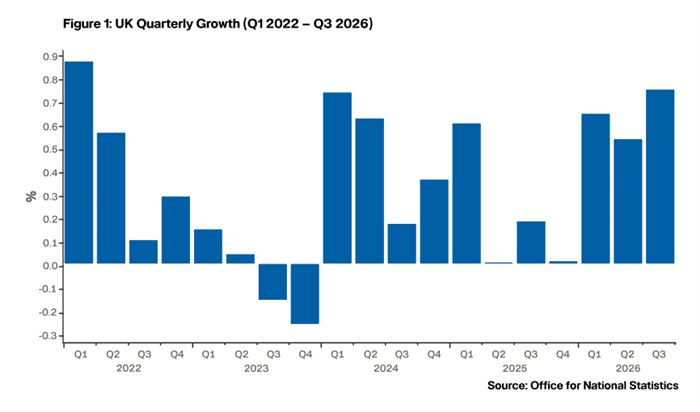
Figure 1

However, a slowdown in growth now seems inevitable. It is worth emphasising that the major increases in gas prices only started in the summer and the impact on the UK economy has been delayed by several factors. Many businesses are on fixed-rate contracts or have used energy hedging strategies and the household energy price cap means that gas price increases are only set to fully bite next year – Ofgem announced a 26% rise from January 1.  In summary, the full hit from the energy price shock is yet to be felt. 
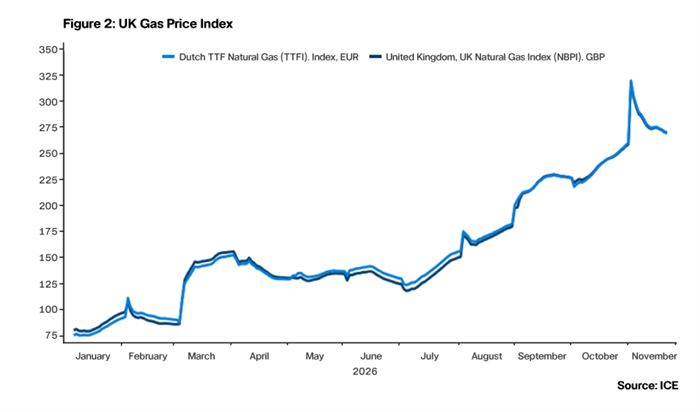
Figure 2

Turning to employment. The most recent jobs data ostensibly points to some stabilisation in the labour market given the headline rate of unemployment appears to have fallen. Yet the headline figures conceal the “low hire, low fire” dynamic playing out, something highlighted by MPC member Clare Lombardelli Opens in a new window at the BoE Watchers Conference earlier this month. One of the key problems with this trend is that it is serving to shut many younger people out of the labour market, with youth unemployment rising notably over the past four years. 

Furthermore, the retail and hospitality sectors – which disproportionately hire younger people – have been especially affected by increasing hiring costs. 
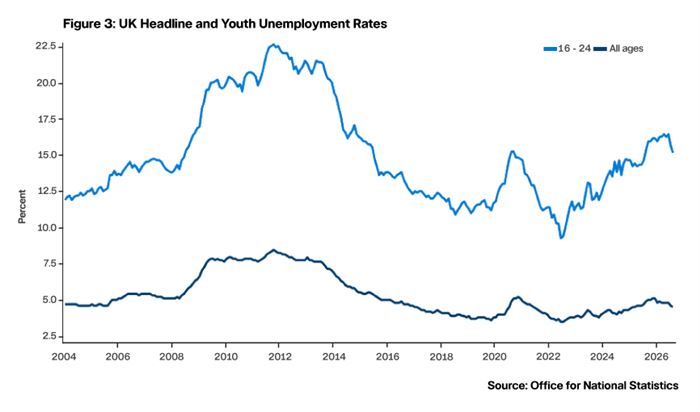
Figure 3

Since the last Rate Wrap, we had the first increase in base rate since the start of the US-Iran war. All members of the Monetary Policy Committee backed a rate increase and it seems clear now that the median MPC member will view the combination of strong growth, rising inflation and signs of a stabilising labour market as reasons for rates needing to go up further. 

Our current view is there will be just one more hike in rates this cycle – which is notably below financial markets’ pricing – although this depends on geopolitical risk receding next year. However, if this scenario were to play out, it would point to some relief in the mortgage market in 2027 and 2028 as gilt yields move onto a downward trend next year with the shorter-end of the yield curve falling more than the longer-end. 

You can find more information about our UK financial forecasts in the latest Handelsbanken Macro Comment Can gilts’ recent outperformance be sustained? Opens in a new window. 

Daniel Mahoney, Senior Economist, UK
A view from the dealing desk

The Bank of England turns hawkish

The Bank of England delivered its first rate increase in three years on 5 November, citing a revised inflation outlook that now sees CPI approaching 5% next year. The decision itself was notably hawkish, passing by an 8-1 margin, with Catherine Mann the sole dissenter due to her preference for a larger 50bps increase. Governor Andrew Bailey subsequently emphasised that the path for rates remains closely tied to developments in the US-Iran conflict, with energy prices likely to be a key driver of where bank rate ultimately peaks.

Markets reacted by pulling forward expectations for further tightening, with traders pricing in the probability of another hike on December 17 to around 54%, up from roughly 30% beforehand, whilst also firming up expectations for a total of four rate increases during the current cycle. At the start of November, financial markets had broadly expected the next bank rate increase to come in either February or March. 

Since then, sentiment has shifted materially, with a December hike now viewed as around 80% likely. That view has been reinforced by recently hawkish MPC commentary, with Deputy Governor Clare Lombardelli suggesting another increase may be needed "in the near term" and Chief Economist Huw Pill stating there is still "further to go".

The October CPI release on November 18 brought a little market relief despite largely meeting expectations, with headline inflation edging up to 3.6% from 3.5% and core inflation remaining unchanged at 2.8%. The more encouraging surprise was services inflation holding steady at 3.7% rather than moving higher. 

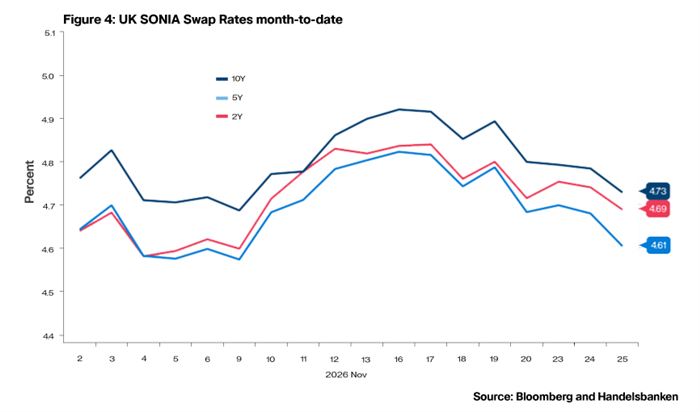
Whilst not a dramatic miss, it was enough to prompt a modest rally in rates markets, with swap rates falling 4-5bps across much of the curve as investors weighed the possibility that easing energy prices could help inflation cool more quickly than feared.

All told, this sees swap rates still trading around the 4.75 level, although notably 5-year swap rates are c.5-10bps lower, with markets starting to price in a cut somewhere in 2-3 years’ time, but with no fundamental change to this current hiking cycle. Instead the biggest move this month has been at the front end of the curve, where one-year swap rates rose around 16bps during November, compared with only 4-5bps for ten-year rates, reflecting expectations that further rate rises could come sooner rather than later. 

Figure 4

Why economists and traders disagree

One of the more interesting developments in recent weeks has been the widening gap between market pricing and economists' forecasts. Markets currently imply bank rate will peak at around 4.75-5.00%, whereas consensus economist forecasts remain closer to 4.25%. That divergence is now among the largest seen in the last twenty years.

The obvious conclusion would be that traders have become significantly more hawkish than economists. However, that is not necessarily the case. Part of the explanation may be that investors are paying a premium to hedge against the risk of higher rates rather than simply expressing a view on where bank rate is heading. If so, market pricing could be overstating the eventual peak, particularly if geopolitical tensions ease (as Daniel talks about above) and energy markets stabilise. As ever, swap rates represent the market's opinion rather than market fact.

Could the AI trade become a rates story?

One increasingly intriguing question is what happens if the long-awaited unwinding of the AI trade gathers pace?

Equity markets have already shown signs of strain, with the S&P 500, FTSE 100 and Euro Stoxx 50 all moving into drawdown territory, whilst the tech-heavy Nasdaq has moved into correction territory having fallen over 14% from its recent peak and is overall down nearly 6% since the start of November. Recent volatility surrounding major AI-related stocks has only intensified debate about whether investors have become overly enthusiastic about the sector. 

Investors have largely sought safety in sovereign debt, helping drive the rally in government bonds seen during the second half of the month. UK gilts in particular have benefited, reflecting their status as a favoured defensive asset among British pension funds and insurance companies. 

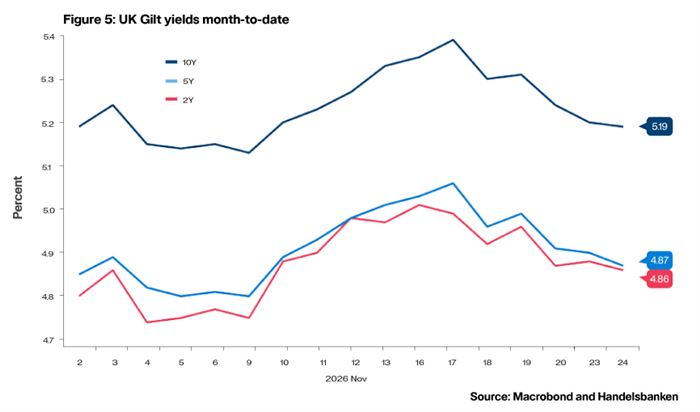
Prior to October’s inflation release, yields had been pushing towards levels last seen during the volatility which followed Liz Truss' mini-budget, with ten-year yields briefly reaching 5.37%. Since then, cooling inflation expectations have helped yields retrace some of that move, and gilt-swap spreads have narrowed modestly as gilt yields have fallen more quickly than swap rates from their mid-month highs.

Figure 5

The gilt-SONIA swap spread remains significantly wider at longer maturities, however, standing at 13.1bps in two-year tenors compared with 41.5bps and 63.5bps in ten and thirty-year maturities respectively. That suggests that much of the difference between gilt yields and swap rates remains driven by risk premium rather than expectations for additional monetary tightening.

The complication remains inflation. Whilst weaker equity markets would normally favour lower yields, stubborn price pressures and elevated energy costs continue to pull in the opposite direction. Should Brent crude move back above $100pb, rates markets could quickly reverse course.

For now, swap rates appear caught between two competing forces: inflation risks pushing rates higher and growing market caution pushing them lower. If concerns around growth and equities deepen, shorter-dated swap rates could fall faster than longer maturities. Equally, any upside inflation surprise would likely see markets revisit the higher-rate narrative. As a result, volatility looks set to remain a feature of rates markets for some time yet.

Thomas Barker, Handelsbanken Markets

Important information

All the opinions, forecasts, estimations and comparable information expressed in this email are the subjective views of the author and have not been independently verified or corroborated. Accordingly it is not and does not purport to be objective research. Handelsbanken plc does not accept liability to any person who relies on the content of this email and accompanying attachments, if any. Handelsbanken plc makes no guarantee, representation or warranty and accepts no responsibility or liability as to the completeness of the information contained in this email and accompanying attachments and none of Handelsbanken plc’s officers, directors, or employees makes any guarantee, representation or warranty, nor does any such person accept any responsibility or liability for any loss of profit, indirect or other consequential losses or other economic losses suffered by any person arising from reliance upon any information, statement or opinion contained in this email and any accompanying attachments (whether such losses are caused by the negligence of such person or otherwise). Handelsbanken plc and/or its directors, officers or employees may have, or have had interests in, and may at any time make purchases and/or sales as principal or agent or may provide or have provided corporate finance and or other advice or financial services to the relevant companies. All information in this material is expressed as at the date of this email and is subject to changes at any time without prior notice or other publication of such changes. Past performance is not necessarily indicative of future results. This e-mail may be confidential. If you have received it in error please note that you may not copy or use the contents or attachments in any way. Please destroy this entire message and notify the sender. E-mails are not secure and Handelsbanken plc cannot accept responsibility if they are intercepted, diverted or corrupted or contain viruses. Handelsbanken Capital Markets is a trading name of Handelsbanken plc, which is incorporated in England and Wales with company number 11305395. Registered office: 25 Basinghall Street, London, EC2V 5HA, UK. Handelsbanken plc is authorised by the Prudential Regulation Authority and regulated by the Financial Conduct Authority and the Prudential Regulation Authority. Financial Services Register number 806852. Handelsbanken Capital Markets is the trading name of both: (i) Handelsbanken plc; and (ii) Svenska Handelsbanken (AB) publ, which is incorporated in Sweden with limited liability. Registered in Sweden No. 502007 7862 Head office in Stockholm. Authorised by the Swedish Financial Supervisory Authority (Finansinspektionen). Handelsbanken plc is a wholly-owned subsidiary of Svenska Handelsbanken AB (publ).