
How long is ‘long-term’?
The expression ‘long-term’ can mean different things to different people, depending on a wide range of factors particular to them. When it comes to investment timelines, though, we tend to view investment performance over a period of no fewer than five years.
Why should we take a long-term approach to investing?
It is inevitable that, over the short term, a portfolio’s value will be impacted by fluctuations and events in investment markets. In some years, when market conditions are at their most challenging, it can be very difficult for investment portfolios to make gains above inflation. In others, they can substantially outperform their targets.
We believe that taking a longer-term view gives investments time to perform in different market and economic conditions, and allows for a better assessment of how well these assets are working for their investors.
A long-term investment approach also allows for an important process known as ‘compounding’.
What is ‘compounding’ and how does it work?
Taking a long-term approach to investing means allowing your investment to access better growth over time. This takes significant patience, but the results can pay off substantially over time. Why is this?
This is due to the process of ‘compounding’, which typically proves much more pronounced over longer time periods. Of course, past performance is never a reliable guide to future performance, and the value of investments can rise or fall depending on a huge array of factors. However, remaining invested and leaving your investments to work over a longer time period provides the most reasonable opportunity for this process to work.
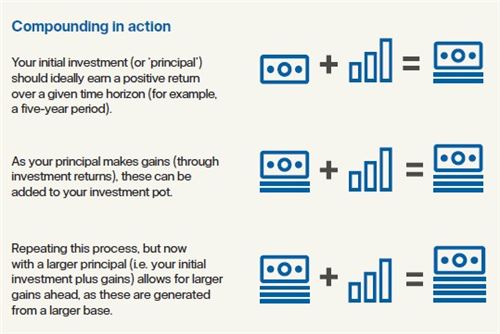
When we talk about compounding, we are effectively referring to the process of letting any gains build on themselves over time, as the illustration on the next page demonstrates.
Wouldn’t it be better to react to near-term changes in markets?
Savvy asset managers should be cognisant of all factors – near-term and longer-run –impacting financial markets. However, attempting to predict short-term events in world markets with pinpoint accuracy is a problematic endeavour, and the consequences of an ill-timed guess can be catastrophic for an investment portfolio’s value.
Some investors are happy to take on extreme risks in their investment portfolio in pursuit of financial gain. However, faced with portfolio losses, investors can find themselves losing faith very quickly, and often at precisely the wrong time. Indeed, often the largest returns can occur when the picture seems the worst. For example, the benefit of hindsight tells us that the lows of the 2008 financial crisis and the worst market falls during the early stages of the COVID-19 pandemic could each have provided excellent entry points to many areas of financial markets.
Does a long-term approach eliminate risk?
Risk can never really be eliminated within an investment portfolio, but it can be well managed. What’s more, risk is an important feature of investment markets, and in many ways a welcome one: without taking on some risk, there can be no potential for greater reward.
With this in mind, even long-term-oriented portfolios need to be nimble and flexible, allowing for opportune purchases and sales of assets where required. We believe that long-term investment strategies should include a carefully selected blend of assets, designed to match their investors’ risk tolerances and investment needs. These positions will likely include a mixture of ‘buy and hold’ positions (steady investments which will broadly be maintained throughout a range of market conditions) and more flexible positions which reflect high conviction views on the contemporary outlook for financial markets and the economy.
Taken together, we believe this approach offers the best potential for a smoother investment journey over the long run, whilst still offering the opportunity to participate in positive market moves. Of course, there may be prolonged periods when an investment strategy does not appear to be working as expected, but portfolios can ultimately emerge stronger as their assets capture improving performance in the market’s natural cycles.
Historical performance remains an unreliable guide to future success. However, the most successful long-term investors tend to be those who have invested in a well-diversified range of assets which are tailored to their goals, tolerance for risk and investment time horizon. Most importantly, they give their chosen strategy plenty of time to perform.